






















































Big Canada Work Permit Change Coming? IRCC Plans New Language Test Rule for 2026
Canada may add language tests for some open work permits in 2026. Learn how new IRCC rules could impact workers, SOWPs, and Canada PR.
Canada may soon introduce a major change for some foreign workers applying under the International Mobility Program (IMP), as the federal government moves closer to introducing language testing requirements for certain work permit applicants.
While the rule has not yet been finalized, the latest update from Immigration, Refugees and Citizenship Canada (IRCC) signals that the proposal is advancing toward formal publication in spring or summer 2026. If implemented, this change could reshape eligibility for some open work permits and potentially affect pathways to permanent residence.
For temporary residents, employers, and families relying on open work permits, understanding what is confirmed — and what remains uncertain — is now more important than ever.
What Has IRCC Announced?
IRCC has updated its Forward Regulatory Plan, confirming progress on proposed amendments to Canada’s immigration regulations involving language proficiency requirements for certain work permit applicants under the International Mobility Program.


The department now expects to pre-publish the proposed regulation in the Canada Gazette during spring or summer 2026 — an important step before any immigration rule becomes law.
This development marks a significant shift from earlier discussions in 2025. The proposal has already moved through consultation phases involving provinces, territories, and private-sector stakeholders, suggesting the government is actively preparing for regulatory implementation.
However, the proposal is not yet law, and no applicant is currently required to submit language test results because of this planned change.
Key Changes Explained
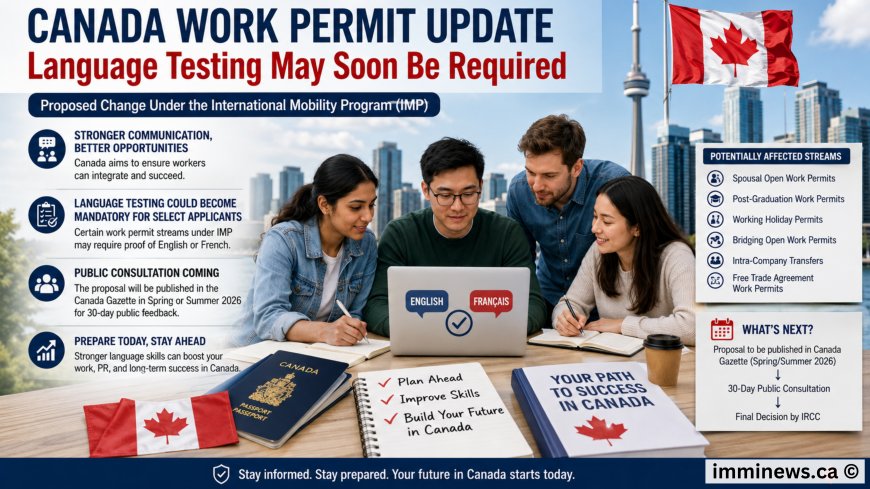
1. Language Testing Could Become Mandatory for Certain Work Permit Applicants
IRCC is proposing authority to require language proficiency results from approved third-party testing organizations for some applicants under the International Mobility Program.
The objective appears to be straightforward: ensure temporary foreign workers entering Canada possess stronger communication skills to improve labour market integration and long-term settlement outcomes.
Although IRCC has not identified which exact permit streams will be included, the proposal suggests that selected applicants may eventually need to demonstrate English or French proficiency before receiving a work permit.
2. The International Mobility Program Could See New Eligibility Standards
The International Mobility Program allows foreign nationals to work in Canada without a Labour Market Impact Assessment (LMIA) in many cases.
Several permit categories operate under this framework, including open and employer-specific work permits.
Potentially affected streams may include:


- Spousal open work permits (SOWPs)
- Post-graduation work permits (PGWPs)
- Working holiday permits
- Bridging open work permits
- Intra-company transfer permits
- Free trade agreement-based work permits
However, IRCC has not officially confirmed which categories will face language testing requirements.
3. A Public Consultation Window Is Coming
Before any regulation becomes effective, the proposal will first appear in the Canada Gazette, Part I.
This stage is critical because it launches a 30-day public consultation period, allowing immigration lawyers, RCICs, employers, applicants, and the general public to submit feedback.
Following this consultation, IRCC can revise, delay, narrow, or finalize the proposal before official implementation through Canada Gazette Part II.
In short: the policy remains under review and could still change significantly.
Why Is Canada Introducing This Change?
The proposed language testing rule aligns with Canada’s broader immigration strategy of selecting temporary residents who are more likely to integrate economically and transition into permanent residence.
Several policy factors appear to be driving this move:
Labour Market Integration
Workers with stronger English or French skills often adapt faster to Canadian workplaces, communicate more effectively, and experience improved employment outcomes.
Stronger PR Transition Outcomes
Canada immigration programs — particularly Express Entry — already place heavy emphasis on language ability through the Comprehensive Ranking System (CRS).
By introducing language testing earlier in the immigration journey, IRCC may be attempting to prepare temporary workers for future Canada PR pathways.
Better Immigration System Control
Canada has tightened multiple temporary residence programs over the past two years amid concerns surrounding housing pressure, labour market alignment, and overall immigration system sustainability.
This proposal appears consistent with Ottawa’s broader strategy of prioritizing quality, retention, and long-term economic contribution.
Impact Analysis: Who Could Be Affected?
Temporary Workers
Foreign nationals applying under affected IMP streams may face additional eligibility requirements if language testing becomes mandatory.
This could increase preparation time, application costs, and documentation requirements.
At the same time, applicants with strong English or French proficiency may gain a competitive advantage.
Spousal Open Work Permit Applicants
Spousal open work permits could become one of the most closely watched categories.
Although IRCC has not explicitly named SOWPs, many immigration professionals believe they could eventually be included due to recent tightening measures already introduced for spouse eligibility.
For families planning relocation, this uncertainty creates an added layer of planning risk.
Post-Graduation Work Permit Holders
Many international graduates are already familiar with language requirements because recent PGWP changes introduced minimum language benchmarks for some applicants.
As a result, graduates may adapt more easily if future work permit rules expand language requirements.
Permanent Residence Candidates
For individuals planning to apply through Express Entry or provincial immigration pathways, earlier language testing could actually provide a strategic advantage.
Applicants may be encouraged to complete approved language exams sooner, helping strengthen their Canada PR profiles in advance.
Winners and Losers: Who Benefits Most?
Winners
- Highly Skilled Applicants
Workers with strong English or French ability could face fewer barriers and improve both employment and permanent residence opportunities. - Employers Seeking Better Workforce Integration
Businesses may benefit from improved communication standards and reduced onboarding challenges. - PR-Oriented Temporary Residents
Applicants already preparing for Express Entry may gain efficiency if one language test serves multiple immigration purposes.
Losers
- Applicants With Lower Language Ability
Individuals lacking language proficiency may face delays or reduced eligibility for certain work permit categories. - Families Dependent on Spousal Open Work Permits
If SOWPs become subject to testing, some spouses may encounter new barriers to joining or remaining with partners in Canada. - Last-Minute Applicants
Those who wait until final implementation may face sudden pressure to prepare for language testing requirements.
Expert Insight: What This Means for Canada Immigration
From an immigration strategy perspective, this proposal signals a broader transformation in how Canada immigration policies are evolving.
IRCC is increasingly aligning temporary residence pathways with permanent immigration outcomes. Instead of viewing temporary permits and Canada PR as separate systems, policymakers appear to be building a more integrated immigration pipeline.
This is particularly important because language proficiency remains one of the strongest predictors of economic success and permanent residence eligibility.
If language testing becomes mandatory for selected work permits, applicants may need to think about immigration planning much earlier than before.
Rather than preparing for language exams only at the Express Entry stage, temporary residents may soon need to approach language readiness as an early immigration requirement.
That would represent a meaningful shift in Canada’s immigration framework.
Strategic Advice for Applicants
- Do Not Panic or Rush to Book Tests
The rule is not finalized, and no language requirement currently applies because of this proposal. - Monitor Official IRCC Updates Closely
Watch for publication in the Canada Gazette during spring or summer 2026. - Prepare Early if PR Is Your Goal
If you plan to apply for Express Entry, taking an approved language test sooner could strengthen your immigration strategy. - Review Your Work Permit Category
Not all International Mobility Program streams may be affected. Wait for official confirmation before making decisions. - Consult a Licensed Immigration Professional
Once regulatory details are published, seek guidance to understand how the changes may affect your specific situation. - Improve Language Skills Proactively
Even if testing becomes optional for your stream, stronger language ability can improve both employment and permanent residence opportunities.
What Remains Unconfirmed?
Despite the regulatory progress, several critical details remain unknown:
- Which exact IMP streams will be affected
- Whether spousal open work permits will be included
- Approved language tests
- Minimum required scores
- Exemptions for specific applicants
- Transitional rules for pending applications
- Final implementation date
Until IRCC publishes the proposed legal text, any assumptions about required scores or affected permit categories remain speculative.
Canada’s proposed language testing requirement for certain open work permit applicants marks an important immigration development that could influence thousands of temporary residents.
Although the proposal is moving closer to formal publication, nothing has changed yet for applicants today. The coming Canada Gazette release will provide the first real clarity on who will be affected and what standards may apply.
For now, preparation — not panic — is the smartest approach.
As Canada continues reshaping temporary and permanent immigration pathways, language proficiency is emerging as an increasingly central factor in long-term immigration success. For applicants hoping to build a future in Canada, staying informed may become just as important as meeting eligibility requirements.
What's Your Reaction?
 Like
0
Like
0
 Dislike
0
Dislike
0
 Love
0
Love
0
 Funny
0
Funny
0
 Angry
0
Angry
0
 Sad
0
Sad
0
 Wow
0
Wow
0