














































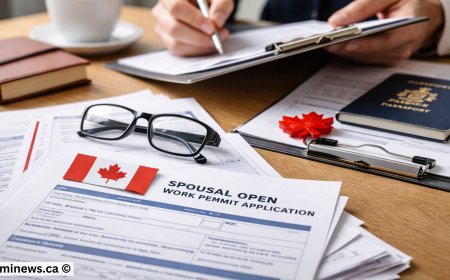



Spousal Open Work Permit: PGWP vs LMIA Explained
Understand PGWP vs LMIA for Spousal Open Work Permits in Canada. Learn how IRCC assesses eligibility and how to avoid refusals.
The Spousal Open Work Permit (SOWP) is one of the most powerful yet misunderstood options in Canadian immigration. Every year, thousands of couples apply, believing eligibility is automatic—only to face refusal because of incorrect assumptions. One of the most common and damaging misunderstandings revolves around this single question: Does it matter whether the principal applicant holds a Post-Graduation Work Permit (PGWP) or an LMIA-based work permit?
Under IRCC policy, the answer is very clear: yes, it matters—but not in the way most people think. Neither category is inherently stronger or safer. What truly matters is how immigration officers assess each category and how well the application aligns with those expectations. Understanding this distinction is essential for anyone applying for a Canada visa through spousal work authorization in 2024 and beyond.
Significance of Spousal Open Work Permit: PGWP vs LMIA
The distinction between PGWP and LMIA-based work permits is significant because IRCC officers do not assess Spousal Open Work Permit applications using a single universal standard. Instead, officers evaluate eligibility through the lens of the principal applicant’s status, employment structure, and long-term work authorization stability. Applicants who fail to understand this difference often submit technically complete applications that are substantively weak.
At its core, a Spousal Open Work Permit allows the spouse or common-law partner of a temporary resident in Canada to work for almost any employer, without requiring a job offer or an LMIA. However, eligibility is never automatic. Officers assess whether the principal applicant’s employment situation meets specific criteria, and those criteria shift depending on whether the individual holds a PGWP or an LMIA-based permit. This is where many applicants go wrong—and where refusals begin.
How IRCC Evaluates PGWP-Based Spousal Applications
When the principal applicant holds a Post-Graduation Work Permit, IRCC’s focus shifts almost entirely to the job being performed, not the education that led to the work permit. Studying in Canada, completing a diploma, or graduating from a master’s program does not, by itself, make a spouse eligible for an open work permit. Officers are instructed to look beyond credentials and examine real-world employment.


For PGWP holders, the job is the backbone of the entire application. Officers assess whether the applicant is actively employed, whether the occupation falls under an eligible NOC category, and whether the job duties align precisely with that NOC. Even minor inconsistencies between job descriptions, employer letters, and actual duties can raise credibility concerns.
This is why many applicants are surprised by refusals. They assume their Canadian education carries weight when in reality, IRCC places far more importance on whether the employment demonstrates skilled, eligible work. A strong breakdown of what officers truly assess can be found in this analysis of what IRCC really looks for in Spousal Open Work Permit applications, which highlights why job alignment is critical.
Common PGWP Errors That Lead to Refusals
One of the most frequent errors PGWP holders make is choosing a NOC code based on job title rather than job duties. Immigration officers are trained to ignore titles and examine actual responsibilities. If the duties suggest a lower-skilled or ineligible occupation, the application weakens immediately.
Another recurring issue is timing. Many PGWP holders apply when their work permit is close to expiry, assuming processing will be quick or that an extension will be granted. IRCC does not operate on assumptions. Officers consider whether the principal applicant has sufficient remaining work authorization to justify issuing an open work permit to the spouse. When validity is short, refusal becomes more likely.
These mistakes are avoidable, but only when applicants understand how IRCC interprets PGWP-based cases. Many successful applicants first verify their eligibility by reviewing expert guidance on whether they are truly eligible for a Spousal Open Work Permit in Canada before submitting an application.
How LMIA-Based Spousal Applications Are Assessed
For applicants holding an LMIA-based work permit, the assessment framework is slightly different but no less strict. An LMIA indicates that the employer has already demonstrated a genuine labour market need and has received government approval to hire a foreign worker. This adds a layer of credibility to the employment, but it does not guarantee approval for the spouse.
IRCC officers still examine whether the employment is ongoing, whether the job offer remains valid, and whether the documentation supports the claimed work arrangement. Employer letters must clearly outline duties, wages, and job continuity. Payslips must demonstrate active employment. Any inconsistency between documents can undermine the application, even with a valid LMIA.
A widespread misconception is that an LMIA automatically qualifies a spouse for an open work permit. This belief leads many applicants to submit weak or incomplete supporting documents, assuming the LMIA alone is sufficient. In reality, officers treat the LMIA as supportive evidence—not as a replacement for proper documentation.
IRCC’s broader approach to family-based immigration and credibility assessment is reflected in the Government of Canada’s official sponsorship and family immigration guide, which emphasizes consistency, genuineness, and long-term compliance.
Why Neither PGWP nor LMIA Is Automatically “Stronger”
One of the most important realities applicants must accept is that there is no universally stronger category. A PGWP holder with a well-documented, eligible job and correct NOC alignment can have an exceptionally strong Spousal Open Work Permit application. Conversely, an LMIA holder with vague employer letters, missing payslips, or unclear job duties can face refusal despite holding government-approved authorization.
IRCC does not approve applications based on labels. Officers approve applications based on clarity, consistency, and credibility. Strength comes from alignment between the work permit, the job, the documentation, and the timing—not from the name of the work permit itself.
This is why professional preparation matters. Applicants who understand how officers think can structure their applications to meet expectations rather than assumptions. Many couples choose to review their strategy using resources available on the A2Zimmi immigration platform, where practical, experience-based guidance helps reduce refusal risk.


Why Understanding This Difference Prevents Refusals
Most Spousal Open Work Permit refusals are not the result of ineligibility. They occur because applicants misunderstand how IRCC assesses PGWP versus LMIA cases. When expectations do not match officer logic, even genuine relationships and lawful employment can fail to meet the standard.
Understanding which category you fall under allows you to verify NOC eligibility, confirm work permit validity, strengthen employer documentation, and apply at the right time. These decisions significantly improve approval outcomes and reduce delays, stress, and financial loss.
The distinction between PGWP and LMIA is one of the most significant factors influencing Spousal Open Work Permit outcomes. While both pathways are valid under Canada immigration law, they are assessed differently by IRCC officers. Education alone does not secure approval. An LMIA alone does not guarantee success. What determines the outcome is alignment—between job duties, NOC classification, documentation quality, and work permit validity.
Before applying, identify your work permit category, understand how IRCC evaluates it, and prepare accordingly. Most refusals can be avoided by addressing these factors early rather than reacting after a refusal. For personalized guidance, deeper eligibility analysis, or professional case assessment, explore trusted resources or book a consultation through A2Zimmi’s consultation platform.
What's Your Reaction?
 Like
0
Like
0
 Dislike
0
Dislike
0
 Love
0
Love
0
 Funny
0
Funny
0
 Angry
0
Angry
0
 Sad
0
Sad
0
 Wow
0
Wow
0