













































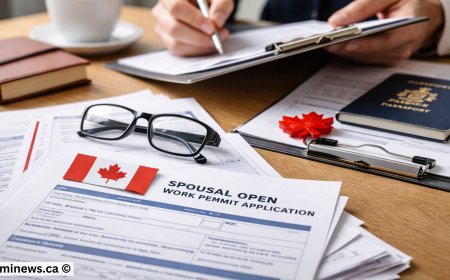



Spousal Open Work Permit in Canada – Are You Truly Eligible?
Learn who qualifies for a Canada Spousal Open Work Permit, its benefits, and how to avoid common application mistakes. Expert guidance included.
Canada remains one of the most sought-after destinations for skilled workers and their families. Among the many immigration pathways, the Spousal Open Work Permit (SOWP) has become increasingly popular. This permit allows the spouse or common-law partner of a temporary worker in Canada to work for almost any employer without requiring a Labour Market Impact Assessment (LMIA) or a pre-arranged job offer.
However, many applicants misunderstand its eligibility criteria, assuming that simply being married or holding a Canadian degree automatically qualifies them. In reality, eligibility for a spousal open work permit depends heavily on the work permit status and occupation of the spouse already in Canada. Understanding these rules is crucial to avoiding application refusals and costly delays.
Benefits of a Spousal Open Work Permit
A spousal open work permit offers multiple advantages for families moving to Canada. From enhancing financial stability to supporting career development, this permit plays a significant role in helping couples adapt successfully.
1. Flexibility to Work for Any Employer
One of the biggest benefits of a spousal open work permit is its flexibility. Unlike employer-specific work permits, the SOWP allows spouses to work for any employer across Canada, providing freedom to pursue opportunities aligned with their skills and career goals.
There is no requirement for an LMIA, which means you don’t need a specific employer to sponsor you. The Canadian government confirms that spouses of temporary workers may be eligible for open work permits under specific conditions (Government of Canada – Family Sponsorship).


For detailed guidance on speeding up your spousal visa process, check out How to Get Your Canada Spouse Visa Approved Fast. This internal resource provides step-by-step instructions for maximizing approval chances.
2. Improved Financial Security
A spousal open work permit can significantly enhance a family’s financial stability. The ability to work legally allows the spouse to contribute to household income, pay for rent, utilities, and other essential expenses, and even save for long-term goals.
This benefit becomes particularly crucial for families who have recently relocated and are still adapting to Canada’s cost of living. The financial independence that comes with a spousal open work permit also reduces pressure on the primary applicant and allows both partners to thrive in their new environment.
3. Career Development and Skills Enhancement
The SOWP provides an excellent opportunity for spouses to build Canadian work experience, which is highly valued by employers and immigration authorities. Working in Canada enables spouses to pursue professional growth, attend training programs, and expand their career networks.
For instance, spouses working in eligible TEER jobs, such as architectural technologists or civil engineering technicians, gain experience that aligns with the Canadian National Occupational Classification (NOC) standards (Canadim – Spousal Sponsorship).
Additionally, Canadian work experience can be a crucial factor when applying for permanent residency under the Canadian Experience Class (CEC), making the SOWP a strategic step for long-term immigration success.
4. Supports Family Integration and Mental Well-being
Moving to a new country can be emotionally challenging. A spousal open work permit allows couples to live, work, and grow together in Canada, which strengthens family bonds and promotes emotional stability.
Being able to work reduces isolation, enhances social integration, and enables spouses to participate fully in Canadian society. It also provides a sense of independence and contribution, which is essential for mental well-being during relocation.
5. Pathway to Permanent Residency
While temporary, the SOWP is often a stepping stone to permanent residency in Canada. Gaining Canadian work experience can improve eligibility and points under Express Entry programs.
Spouses who work in Canada not only contribute financially but also accumulate experience that can support future permanent residency applications. For expert guidance on eligibility and pathways to permanent residency, you can book a consultation with A2Zimmi.
Eligibility Criteria for a Spousal Open Work Permit
Despite its benefits, not every spouse automatically qualifies for an SOWP. Eligibility primarily depends on the work status and occupation of the spouse already in Canada.
1. Valid Work Permit of the Primary Applicant
The spouse in Canada must hold a valid work permit and be actively employed. Immigration officers evaluate the application based on the current employment situation, not future plans. Typically, the work permit should have at least 16 months of validity remaining to sponsor a spousal open work permit. Temporary permits with shorter validity may reduce approval chances.


2. Occupation and NOC Classification
Canada uses the National Occupational Classification (NOC) system, with TEER levels from 0 to 5, to determine eligibility.
-
TEER 0 (management) and TEER 1 (professional occupations) usually qualify if other conditions are met.
-
TEER 2 and TEER 3 roles are more selective, with only specific occupations eligible, including:
-
Construction estimators (NOC 22303)
-
Architectural technologists and technicians (NOC 22210)
-
Civil engineering technologists and technicians (NOC 22300)
-
Many skilled jobs, such as transport truck drivers (NOC 73300) or heavy-duty equipment mechanics (NOC 72401), do not qualify, even though they are technically skilled.
3. Education Alone Does Not Guarantee Eligibility
A common misconception is that a Canadian diploma, bachelor’s, or master’s degree automatically grants an SOWP. While education may support career potential, eligibility depends on the spouse’s current job and work permit, not the applicant’s education.
For example, a master’s graduate in construction project management may still be refused if the employed spouse’s position does not meet the TEER eligibility requirements.
4. Proof of Genuine Relationship
Applicants must show that the marriage or common-law partnership is genuine and ongoing, through documents such as marriage certificates, joint bank statements, photos, and correspondence. This documentation is critical, as immigration officers closely scrutinize applications to prevent fraud. Submitting strong evidence can significantly increase approval chances.
5. Additional Considerations
Other factors influencing SOWP eligibility include:
-
Length of stay and work permit validity: Insufficient validity reduces approval likelihood.
-
Compliance with Canadian immigration rules: The primary applicant must maintain legal status.
-
Alignment with designated eligible occupations: Only certain TEER 2/3 roles qualify.
For professional guidance on confirming eligibility and submitting a strong application, book a consultation with A2Zimmi.
A Spousal Open Work Permit is a valuable tool for families moving to Canada, providing financial stability, career growth, family integration, and a pathway to permanent residency. However, strict eligibility rules regarding the primary applicant’s work permit and occupation must be followed to avoid costly refusals.
For personalized guidance, visit A2Zimmi or schedule a consultation today. Their experts can help you confirm eligibility, prepare strong documentation, and navigate Canada’s immigration system efficiently. Secure your family’s future in Canada now!
What's Your Reaction?
 Like
0
Like
0
 Dislike
0
Dislike
0
 Love
0
Love
0
 Funny
0
Funny
0
 Angry
0
Angry
0
 Sad
0
Sad
0
 Wow
0
Wow
0