























































Major Express Entry Overhaul: Canada to Remove FSWP, CEC and FSTP Programs
Canada plans Express Entry overhaul, replacing FSWP, CEC and FSTP with a new program. IRCC aims to streamline Canada immigration and reshape PR pathways ahead.
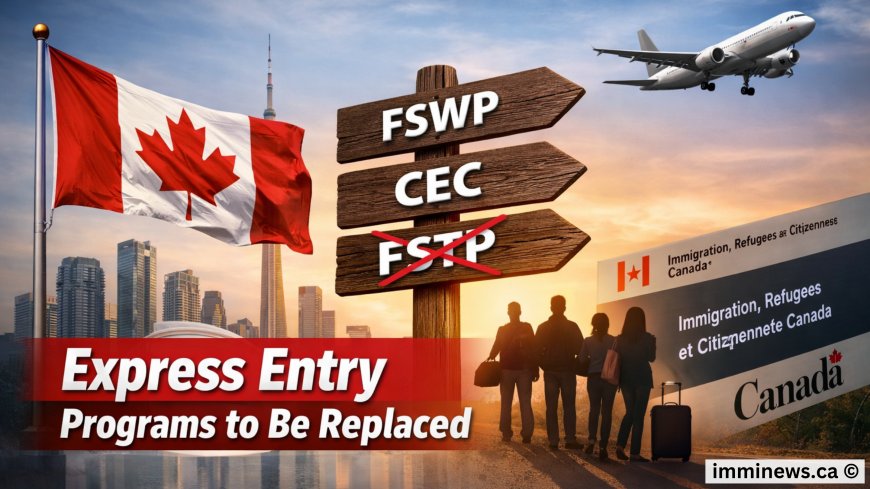
Canada is preparing for a landmark transformation of its Express Entry system, signaling one of the most significant reforms in federal high-skilled immigration since the program was introduced in 2015. Immigration, Refugees and Citizenship Canada (IRCC) has announced plans to retire the current Express Entry programs—including the Federal Skilled Worker Class (FSWC), Canadian Experience Class (CEC), and Federal Skilled Trades Class (FSTC)—and replace them with a single, streamlined immigration class. This move aims to simplify the application process, better align immigration with Canada’s labour market needs, and provide clarity for applicants and employers.
What Has Been Announced
IRCC’s Forward Regulatory Plan 2026–2028 outlines proposed regulatory changes, including:
- Repeal of Current Express Entry Programs: The three federal economic immigration programs under Express Entry will be retired.
- Introduction of a Single New Federal Class: Eligibility criteria will be simplified and standardized across applicants.
- Labour Market Alignment: The new system will aim to fill a broader variety of positions and meet diverse employer demands.
- Ease of Use: Simplified requirements are expected to make the system more transparent and easier to navigate for applicants, employers, and immigration partners.
The IRCC has not yet shared full eligibility details for the new class but has emphasized that public consultations with stakeholders, partners, and the wider public are expected in Spring 2026. Updates will be available on the department’s consultation webpage during that period.
If implemented, this reform will represent the largest structural change to Canada’s high-skilled immigration system in over a decade.


About Express Entry
Express Entry is Canada’s flagship system for managing online permanent residence (PR) applications under economic immigration programs. It operates as a ranking and selection mechanism where eligible candidates are placed in a pool and ranked according to the Comprehensive Ranking System (CRS). The system’s key features include:
- Candidates must meet eligibility criteria for one of the three programs to enter the pool.
- High-ranking candidates are issued invitations to apply (ITAs) during federal draws.
- Applicants have 60 days to submit a full application with supporting documents.
- IRCC aims to process most applications within six months.
In 2025, Canada issued 117,998 invitations to apply for permanent residence through Express Entry draws, demonstrating the program’s central role in Canada’s immigration framework.
Current Programs Under Express Entry
Canadian Experience Class (CEC)
The CEC is designed for candidates with recent Canadian work experience. Eligibility generally requires:
- At least one year of skilled work experience in Canada within the last three years.
- Language proficiency in English or French.
- Meeting other integration criteria, such as adaptability and employment stability.
This program is ideal for individuals who have already integrated into the Canadian labour market and wish to transition to permanent residence.
Federal Skilled Worker Program (FSWP)
The FSWP targets skilled workers with foreign or Canadian work experience. Key criteria include:
- One year of continuous skilled work experience within the last 10 years (can be international).
- Language proficiency in English or French.
- Education credentials and other selection factors such as age, adaptability, and work experience.
FSWP primarily attracts candidates with the skills needed to support Canada’s economic growth, regardless of whether their experience was obtained in Canada.
Federal Skilled Trades Program (FSTP)
The FSTP is aimed at skilled tradespersons in eligible occupations. Key eligibility requirements:


- Two years of full-time work experience in a skilled trade in the past five years.
- Minimum language proficiency.
- Either a valid job offer in Canada or a certificate of qualification issued by a Canadian authority.
This program ensures that tradespersons can contribute to sectors facing labour shortages.
Why This Change Is Happening
The overhaul is part of IRCC’s strategy to simplify Canada’s immigration system while addressing workforce needs more effectively. Key reasons include:
- Reducing Complexity: Consolidating three separate programs into one class eliminates redundancy and reduces confusion for applicants and employers.
- Labour Market Needs: Canada seeks to create a more diverse talent pool capable of filling a broader range of high-demand occupations.
- Accessibility: Streamlined requirements aim to make Express Entry more user-friendly, faster, and easier to navigate.
- Policy Adaptability: A single class allows IRCC to respond flexibly to economic and demographic trends.
Impact Analysis
Students and Recent Graduates
- Graduates with Canadian work experience may benefit from clearer pathways under the new system.
- Post-graduation work permit holders can strategically position themselves to meet revised eligibility criteria.
Work Permit Holders
- The new system may provide smoother PR pathways, especially for individuals in high-demand occupations.
- Those already in Canada should prepare to align their profiles with upcoming program requirements.
Permanent Residence Applicants
- Candidates currently in FSWC, CEC, or FSTP pools may need to monitor changes carefully to ensure eligibility under the new class.
- Transitional rules may be introduced to protect existing candidates’ status and applications.
Winners and Losers
Winners:
- Employers gaining access to a broader, diverse talent pool.
- Applicants benefiting from simplified eligibility and clearer guidance.
Potential Challenges:
- Existing candidates may face uncertainty during the transition period.
- Certain skill-specific or trade-based candidates could experience temporary hurdles until detailed criteria are released.
Expert Insight
From an RCIC perspective, this change is a strategic alignment of immigration with economic objectives. By consolidating pathways, IRCC reduces administrative bottlenecks, enhances clarity, and allows for a more adaptable system. For applicants, this represents both an opportunity and a necessity: staying informed, enhancing CRS scores, and being ready to adapt to new eligibility rules will be critical.
Strategic Advice for Applicants
- Stay Updated: Monitor IRCC announcements, especially Spring 2026 consultations.
- Improve Your CRS Score: Strengthen language proficiency, educational credentials, and Canadian work experience.
- Diversify Pathways: Consider Provincial Nominee Programs (PNPs) or other federal options as alternatives.
- Maintain Documentation: Keep all work experience, educational, and identity documents verified and ready.
- Seek Professional Guidance: Consult a licensed immigration consultant to align strategies with forthcoming changes.
- Plan for Transition: Current Express Entry candidates should strategize to mitigate risks during program restructuring.
Canada’s proposed Express Entry overhaul marks a transformative shift in high-skilled immigration. By replacing three programs with a single streamlined class, IRCC aims to simplify pathways, attract a broader talent pool, and strengthen Canada’s economy. Prospective immigrants must stay informed, proactive, and strategically prepared to navigate the evolving system successfully.
What's Your Reaction?
 Like
0
Like
0
 Dislike
0
Dislike
0
 Love
0
Love
0
 Funny
0
Funny
0
 Angry
0
Angry
0
 Sad
0
Sad
0
 Wow
0
Wow
0