























































NTNP 2026 Update: First-Ever EOI Draw Results Out + Next Draw Dates Announced
Northwest Territories holds first EOI-based NTNP draw in 2026. Learn results, schedule, and how employer-driven Canada immigration impacts PR applicants.
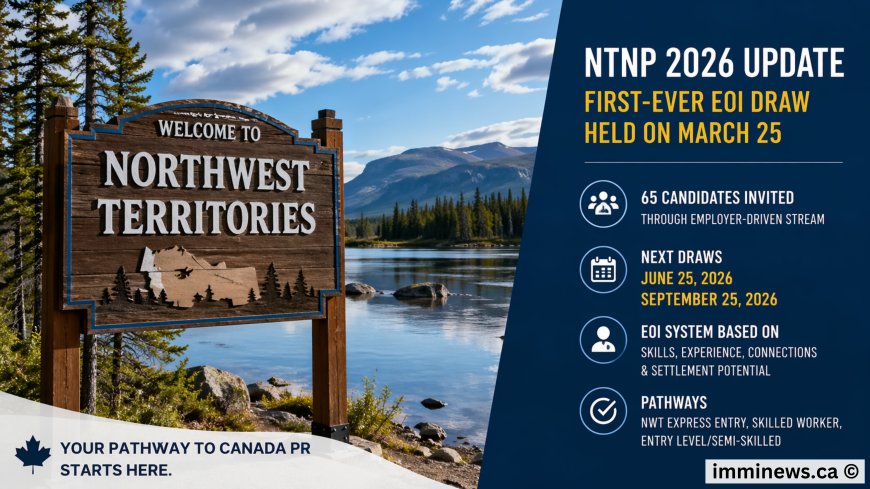
The Northwest Territories has officially entered a new phase in its immigration strategy with the launch of its first-ever Expression of Interest (EOI)-based draw under the Employer-Driven Stream. Held on March 25, 2026, this landmark selection round marks a structural shift in how candidates are assessed and invited under the Northwest Territories Nominee Program (NTNP).
With Canada’s immigration system increasingly focused on targeted selection and regional labor needs, this development signals a more competitive and data-driven approach to provincial nomination in Canada. The change also reflects growing demand for skilled workers in smaller and less-populated regions of the country.
What Has Been Announced
The first draw under the new EOI system selected 65 candidates from a total pool of 295 profiles. All invitations were issued through the Employer-Driven Stream of the NTNP, which prioritizes applicants with confirmed job offers and strong labor market alignment in the territory.
The selection was divided across three pathways:


- NWT Express Entry: 32 invitations
- Skilled Worker: 20 invitations
- Entry Level/Semi-Skilled: 13 invitations
The EOI scores in this draw ranged between 417 and 597, highlighting a relatively competitive threshold even in a smaller provincial pool.
Key Changes in the 2026 NTNP System
The shift from a first-come, first-served model to an EOI ranking system represents a major policy modernization. Under the updated structure, candidates are no longer processed based on submission timing but are instead evaluated and ranked based on a points system.
Under the Employer-Driven Stream of the Northwest Territories Nominee Program, applicants are assessed across three main categories:
- Skills and Experience (up to 375 points)
Includes age, education, language proficiency, and work experience. - Connections to the Northwest Territories (up to 340 points)
Includes existing job offers, current employment, or prior work experience in the territory. - Likelihood of Settlement (up to 130 points)
Includes family ties in the region or previous education in the Northwest Territories.
This structured approach allows the territory to prioritize candidates who are not only qualified but also more likely to remain and contribute long-term.
Why This Change Is Happening
The move toward an EOI system is driven by several strategic factors. Canadian provinces and territories are increasingly under pressure to align immigration with labor shortages while ensuring stronger settlement outcomes.
For the Northwest Territories, the challenges are more specific:
- Limited labor supply in key industries
- High employer dependency on foreign workers
- Need to retain newcomers in remote regions
- Greater demand for transparent selection criteria
By adopting an EOI model, the territory gains flexibility to adjust selection priorities based on real-time labor market needs rather than static application queues.
Impact Analysis
For International Students
Students who have studied in the Northwest Territories gain an advantage under the settlement scoring category. However, without local ties or employment, competition remains challenging.


For Work Permit Holders
Temporary foreign workers already employed in the region are in a strong position, especially those with employer support and ongoing job offers.
For Canada PR Applicants
Candidates targeting provincial nomination through smaller provinces now face a more structured but competitive ranking system. Strong CRS-style profiles alone are no longer sufficient without regional alignment.
Winners and Losers
Winners:
- Candidates with valid job offers in the Northwest Territories
- Skilled workers already employed in the region
- Applicants with prior local experience or education
- Employers seeking faster access to foreign talent
Challenges:
- Applicants without employer sponsorship
- High-scoring candidates with no territorial ties
- Overseas applicants relying solely on general Express Entry profiles
- Entry-level candidates without strong adaptability factors
Expert Insight
From a strategic immigration perspective, this shift represents a clear movement away from passive intake systems toward employer-anchored selection models.
For Canada immigration pathways, especially through Provincial Nominee Programs (PNPs), the emphasis is no longer just on high scores but on “labor market fit.” The Northwest Territories is effectively filtering candidates based on retention probability rather than only eligibility.
This also indicates a broader trend: smaller provinces and territories are tightening selection to ensure that nominated immigrants remain and contribute to local economies, particularly in remote regions where retention is historically challenging.
Strategic Advice for Applicants
- Secure a valid job offer before entering the pool
- Strengthen local ties such as previous work or study in Canada
- Improve language scores to maximize EOI ranking points
- Target provinces with employer-driven nomination systems if CRS is not competitive
- Ensure employer readiness, as nomination begins with employer registration
- Monitor draw deadlines closely to avoid missing submission cut-offs
The introduction of the EOI-based Employer-Driven Stream marks a significant transformation in the Northwest Territories’ immigration strategy. With scheduled draws set for June and September 2026, the system is now structured, competitive, and highly employer-focused.
For candidates planning their Canada PR journey, this development reinforces an important reality: success increasingly depends on regional alignment, employer connection, and settlement potential—not just global ranking scores.
What's Your Reaction?
 Like
0
Like
0
 Dislike
0
Dislike
0
 Love
0
Love
0
 Funny
0
Funny
0
 Angry
0
Angry
0
 Sad
0
Sad
0
 Wow
0
Wow
0